
BLOG & EVENTS

Recent Posts
-
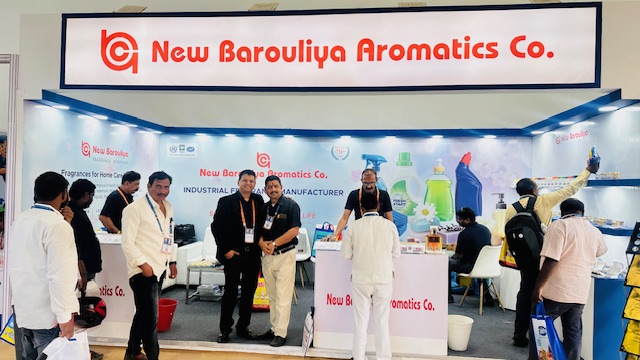 Hyderabad International Soap, Detergent & Cosmetics Expo – February 2026
 -
 Fine Fragrance Compounds: What Manufacturers Must Know Before Sourcing
 -
 Custom Fragrance Development for Beauty Brands
 -
 Why Home Care Product Manufacturers Need a Strong Fragrance Strategy
 -
 How to Source Fabric Care Fragrance in Bulk Without Compromising Quality
Why Home Care Product Manufacturers Need a Strong Fragrance Strategy
Walk into any retail outlet and pick up two floor cleaners with similar formulations, similar price points, and similar packaging. You open one. The scent is fresh, familiar, and somehow reassuring. You open the other one. It smells generic, almost chemical.
Which one goes into the cart?
This is fragrance at work. And for home care product manufacturers, it is one of the most underutilized levers in the entire product strategy toolkit.
Most manufacturers think about fragrance as an ingredient. The ones growing fastest think about it as a business strategy.
The Real Role of Fragrance in Home Care Products
Home care products, from floor cleaners and dishwashing liquids to surface sprays and toilet bowl cleaners, are purchased repeatedly. The buying decision is largely habit-based. Consumers rarely re-evaluate their choice every month.
Fragrance is the primary sensory trigger that reinforces this habit. It creates an unconscious association between the scent and the feeling of cleanliness, freshness, or hygiene. Once that association is built in the consumer’s mind, switching brands feels wrong even if the product performance is comparable.
This is why fragrance is not just an ingredient decision. It is a brand strategy decision. And it needs to be treated as one.
Why Most Manufacturers Get Fragrance Strategy Wrong
The most common mistake home care manufacturers make is treating fragrance as a cost variable rather than a value driver.
The thinking goes like this: fragrance adds to formulation cost, so minimize it. Choose the cheapest option that passes internal smell tests. Move on.
The problem with this approach is that it misses the entire consumer psychology behind fragrance. A fragrance that costs marginally more per unit but creates stronger brand recall can generate significantly better repeat purchase rates. The economics are almost always in favor of investing in a better fragrance strategy.
The second mistake is using generic fragrances that are also used by five other brands in the same category. This makes your product immediately interchangeable in the consumer’s mind, which is the opposite of what you need in a category driven by habit.
Building a Fragrance Strategy: Where to Start
A fragrance strategy for home care products involves four key decisions, and most manufacturers have never explicitly made any of them.
- Define Your Scent Identity
Your brand has a visual identity: a logo, colors, and packaging. It should also have a scent identity. This means choosing fragrance profiles that are consistent across your product range and recognizably yours.
Are you a clean and clinical brand? Citrus and eucalyptus profiles work well. Are you a natural and gentle brand? Lavender, green tea, and herbal profiles signal this clearly. Are you positioned as a premium home care brand? Floral and woody profiles carry a different sensory message.
Defining this scent identity before selecting individual fragrances for each product is the foundation of a coherent fragrance strategy.
- Match Fragrance to Product Function and Consumer Expectation
Consumers have powerful pre-existing associations between scents and functions. Pine and citrus are associated with effective cleaning. Lavender is associated with calm and freshness. Lemon is associated with cutting through grease.
A fragrance that works against these associations will confuse the consumer, even if the product performs well. A floor cleaner that smells of rose may not feel effective to a consumer, regardless of its actual cleaning power.
Matching fragrance to function is not about being conventional. It is about meeting the consumer’s sensory expectation so that the product delivers the right psychological reward.
- Plan for Fragrance Longevity, Not Just Initial Impact
In home care products, the initial burst of scent when the product is opened or applied is only part of the experience. The residual scent that lingers on surfaces, floors, or fabrics after the product dries or rinses is equally important.
This requires working with your fragrance supplier to choose compounds with the right evaporation profile, often called top, middle, and base notes, in the same way fine fragrances are constructed.
A floor cleaner that smells strong when applied but leaves no scent after drying misses a significant opportunity to reinforce the sense of cleanliness long after the cleaning is done.
- Align Fragrance Innovation with Market and Category Trends
The Indian home care market is shifting. Consumers are increasingly aware of ingredients, sustainability claims, and the idea of nature-inspired products. This is creating demand for fragrance profiles that feel natural, clean, and plant-derived even if the product is not technically organic.
Manufacturers who are watching these trend shifts and updating their fragrance strategy accordingly will have a significant advantage over those who stick with the same fragrance profiles for years without re-evaluation.
Your fragrance supplier should be a resource for this kind of market intelligence. If they are not proactively sharing fragrance trend information relevant to your category, that is a signal to evaluate your supplier relationship.
Fragrance Strategy Across Different Home Care Product Categories
Different home care subcategories have distinct fragrance requirements, and a single strategy across your entire range rarely works well.
Floor cleaners and surface sprays benefit from fragrances that are bold, clean, and functional. They need to signal hygiene immediately upon application.
Dishwashing liquids and kitchen cleaners pair well with citrus and herbal profiles that feel food-safe and grease-cutting.
Toilet and bathroom cleaners traditionally use strong disinfectant-adjacent fragrances, but this category is seeing premiumization with floral and spa-inspired profiles in the upper price segments.
Laundry and fabric care products, which overlap with the home care category, require fragrances that survive heat and water and transfer effectively to fabric.
Understanding these nuances within your own product range is a key part of developing a fragrance strategy that actually works in the market.
The Competitive Advantage of Getting Fragrance Strategy Right
When a home care product manufacturer develops a distinct, consistent, and strategically aligned fragrance identity, the commercial benefits are measurable.
Brand recall improves because consumers who recognize the scent across multiple products in a range develop a stronger brand association.
Repeat purchase rates increase because habitual buyers are unconsciously anchored to the scent.
New product launches benefit from existing scent equity, making it easier to introduce line extensions under the same brand umbrella.
Trade channel relationships strengthen because products with strong consumer repeat purchase data are more attractive to distributors and retailers.
None of this happens by accident. It is the result of treating fragrance as a deliberate strategic input rather than a default ingredient choice.
Ready to Elevate Your Results?
A strong fragrance strategy is one of the most cost-effective investments a home care manufacturer can make. It shapes consumer perception, drives repeat purchases, and creates brand identity that is genuinely difficult for competitors to replicate. New Barouliya has been helping home care product manufacturers across India build effective fragrance strategies for over 50 years. From scent identity development to formulation compatibility and trend-aligned fragrance innovation, our team brings both technical depth and market intelligence to every client relationship. If you want fragrance that works harder for your brand, reach out to us today.
